
Putting 20 lb braid on a reel does not give an 8 lb leader the same strength. The leader, its knots and the rest of the outfit still have to handle the pull. Setting drag from the braid label alone can leave the part nearest the fish taking more load than you intended.
Choose a conservative setting for the complete setup, then check it with a suitable scale. The reel’s advertised maximum drag tells you about the reel; it does not tell you how hard to pull with your particular rod, leader and hook.
Decide what you are protecting
Start with sound line and properly tied connections. Inspect the working braid and leader, replace damaged sections and retie questionable knots. Reducing drag is not a repair for frayed line.
For a setup with stronger braid and a lighter leader, the leader is an important limit, but its label is not a measured strength for the finished rig. Both the braid-to-leader connection and the terminal knot matter. So do the rod, hook and the fishing situation.
Check the rod maker’s guidance, including any maximum drag stated at a specified angle. A rod’s line-class marking is not permission to apply that many pounds of drag. If a suitable setting for the line would overload another component, use less pressure or change the setup.
The ReelCalc braid leader guide helps with choosing the leader itself. Set the drag after that choice, rather than choosing a leader to justify a drag setting already on the reel.
Use percentage rules as a starting reference
You will often see a quarter to a third of line strength suggested. Shimano gives roughly one-third as a general rule in its FAQ, and a quarter to a third in its playing-fish guidance. Those are starting references, not a guarantee that every outfit is safe at that pressure.
For example, one-quarter of an 8 lb leader’s labeled strength is 2 lb. That is a calculation to consider when checking a sound, suitable outfit, not a measured recommendation for every 8 lb leader. A poor knot, damaged leader, light hook or rod limit can require a different decision.
Using one-third of the 20 lb braid in the same example would produce about 6.7 lb. That illustrates why the main-line number is the wrong shortcut when a much lighter leader is attached.
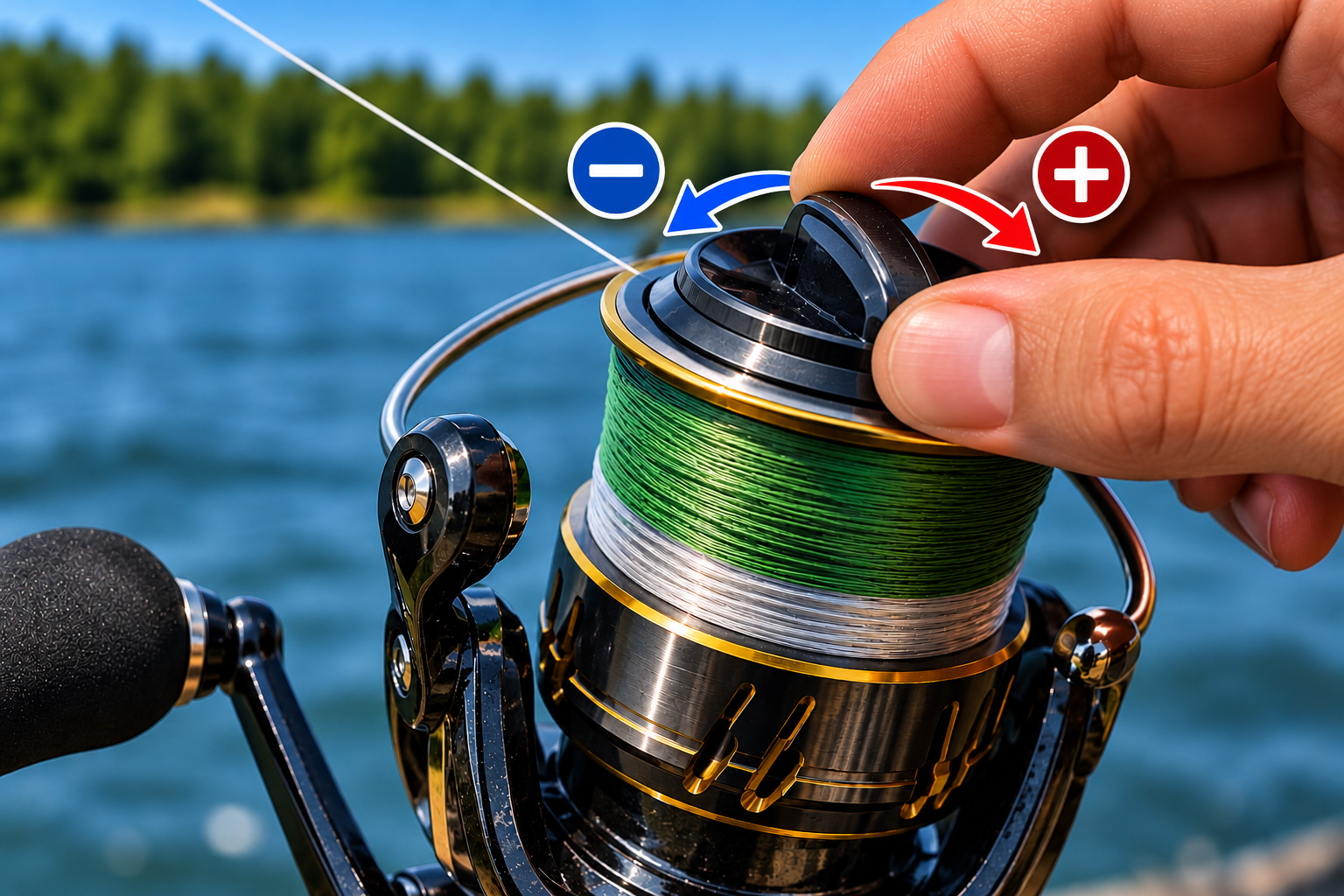
Check the drag with the rig assembled
Use a scale that can read the low loads you intend to measure. A scale designed mainly for very heavy fish may be a poor choice for a light-tackle adjustment. Check its units and instructions first.
Mount the reel on the rod and run the line through every guide. Inspect the tip for an unnoticed wrap. Keep the leader connections you intend to fish in the setup, but remove the lure and exposed fishing hooks.
Connect the leader securely to the scale using a suitable closed attachment. Keep people out of the line of recoil and wear eye protection. Do not wrap line around a hand or test by hanging weights from the rod.
Start with a light drag. Hold the rod at a safe working angle within its maker’s guidance while a helper applies a slow, steady pull through the scale. Keep the test controlled; do not jerk the line or raise the rod into an extreme bend.
Do not turn the handle while the helper pulls line against the drag. Watch the reading as line begins to leave the reel and as it continues moving. Adjust in small increments and repeat the same pull. The aim is controlled release at the intended load, without a pronounced catch followed by a sudden surge. A large startup spike needs attention even if the later running reading looks suitable.
Stop if the rod appears overloaded, a connection moves, the line slips around the arbor or the drag behaves erratically. Investigate the fault rather than tightening until something gives. Keep all equipment within its rated limits throughout the check. After testing, retie and inspect the terminal connection before fishing. A hook-free test does not establish the strength of the fishing hook or its final knot.
What changes on the water
A scale check gives you a repeatable starting point. It does not reproduce every sudden run, rod movement or change in line angle during a fight.
Small hooks and lightly hooked fish may need gentler pressure than a stout single-hook presentation. Braid has little stretch, so consider the rod’s cushioning and your hookset as well as the drag. Avoid trying to compensate for a harsh hookset simply by using a stronger leader.
Recheck the setting after changing leader strength or other important parts of the outfit, and before the next trip. If the drag was loosened for storage, reset it deliberately rather than assuming it is still where you left it.
If the fish and cover demand more stopping power than the outfit can safely provide, change the tackle or the approach. Cranking down the drag cannot strengthen a light leader, and leaving it almost loose is not a useful substitute for choosing suitable equipment either.
The check is complete when you know how the assembled outfit releases line under a controlled pull and the pressure suits its limitations. That is a much better starting point than counting clicks or relying on the braid’s label.
