
How Long Should a Baitcaster Leader Be? Keep the Knot Under Control
A braid-to-leader setup can fish beautifully until the knot starts ticking through the guides—or catches at the baitcaster’s levelwind.
That is why leader length is not just a clear-water question. You also need to decide where the connection will sit when you are ready to cast.
For many everyday bass presentations, starting with roughly 2–4 feet is a practical experiment. It is not a universal optimum. Your rod length, normal casting drop, guide size, cover and reason for using a leader should decide the final length.
Start with the reason for the leader
If the leader is there to put a different material between braid and abrasive cover, think about the section of line likely to contact that cover. A very short leader may not protect enough line.
If it is there to change visibility, consider the water and presentation without assuming a precise length guarantees more bites. A long leader is not automatically more productive than a short one.
If you want more stretch or a different topwater behavior, leader material becomes part of the decision. Fluorocarbon sinks; mono may suit a surface presentation better. Rod action, hook style and drag still matter, because adding a short leader does not turn braid into a full spool of stretchy line.
For main-line choices, use the baitcaster pound-test guide. The general braid leader guide covers material and strength in more detail.
Option 1: Keep the knot outside the rod tip
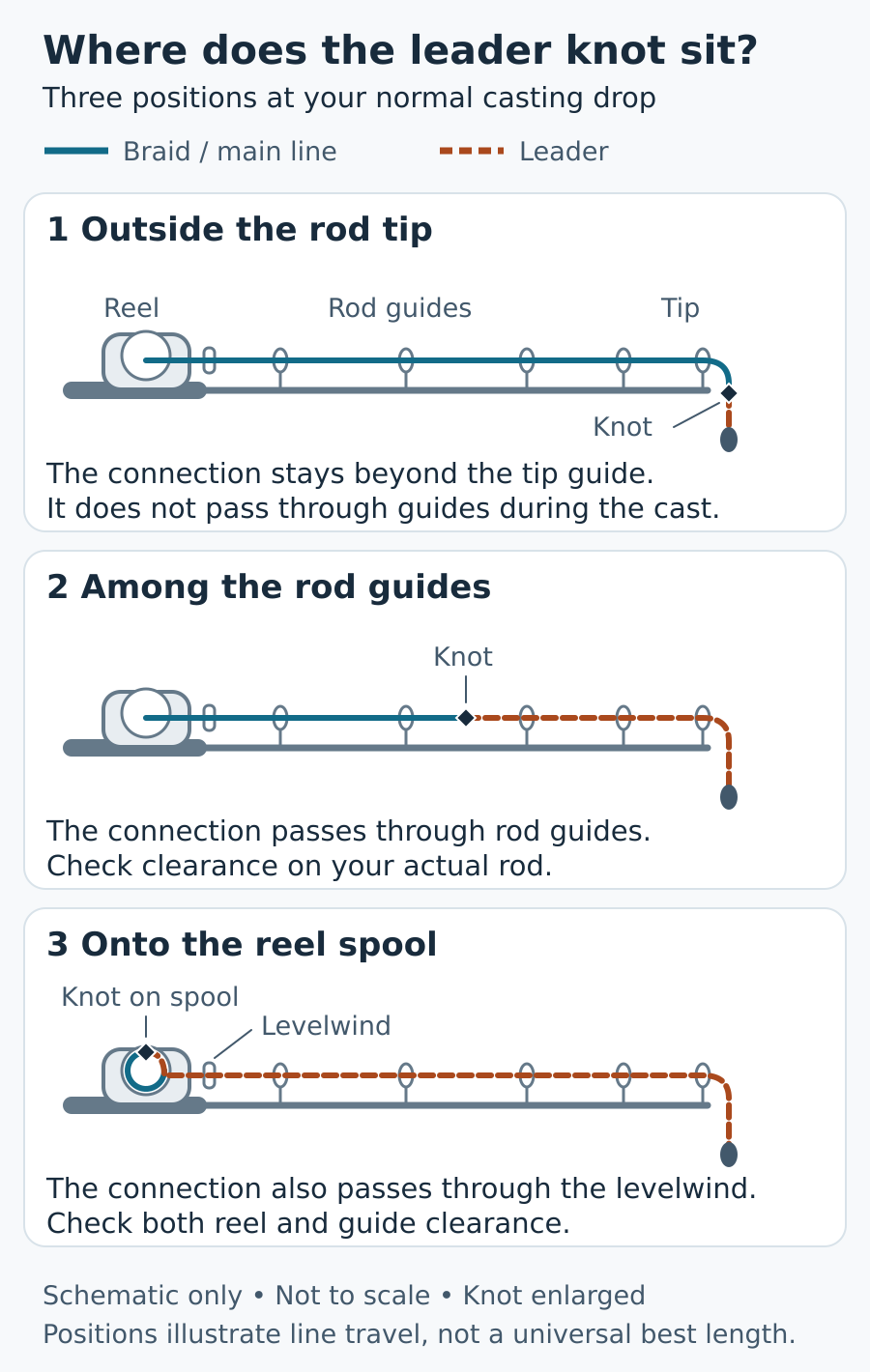
This is the simplest arrangement mechanically. Set your normal lure drop and keep the connection just beyond the tip guide, so it does not travel through the guides during the cast.
The leader must be shorter than the available drop. That can mean a fairly short leader, depending on your casting style. Do not lengthen the drop so much that the lure swings close to you or catches the boat, bank or vegetation behind you.
This option makes sense when a short leader does the job and you want to remove guide clearance from the equation. It also makes knot inspection easy.
The drawback is less allowance for repeated reties. A leader that starts short can soon become too short for its purpose.
Option 2: Let the knot enter the guides, but keep it off the spool
This is a useful middle ground. You gain leader length without winding the connection into the braid on the reel.
Check the knot against the smallest guide on the actual rod. Guide size matters more than the rod’s general description. A connection that passes quietly through one outfit can knock noticeably through another.
A well-tied FG can be useful where a slim connection matters. An Alberto or double uni may suit other combinations, particularly when the knot stays outside the guides. Do not choose a knot solely because it has a reputation for strength; choose one you can tie and seat reliably with those line diameters.
The ReelCalc fishing-knot guide compares the main choices.
Option 3: Wind a long leader onto the reel
A long leader gives more material to work with and more room for reties. It also puts the connection through the levelwind and onto the rotating spool.
That is another clearance check, not an automatic problem. Some outfits tolerate it well; others have a narrow line guide, small rod guides, or a bulky diameter transition.
With the lure removed, retrieve gently and watch the knot pass through the levelwind across its travel. Do not force a knot through a narrow opening. Reattach your lure, then make controlled test casts in a clear area before you put full casting load into it.
If the connection repeatedly catches or the line releases unevenly, shorten the leader, use a suitable lower-profile connection, or choose a different line arrangement. A harder cast is not a sensible clearance test.
Choose strength separately from length
Fifty-pound braid does not require a 50 lb leader. The leader should suit the lure, cover, fish and complete tackle system.
Likewise, a longer leader is not automatically a stronger leader. Every knot, damaged section and abrasion point still matters.
Compare actual diameters in the line database, especially when joining relatively thin braid to heavy mono or fluorocarbon. The physical size difference affects the finished connection.
A leader may be the intended weak point in a setup, but do not assume it will always break at its printed test. Knots and wear change real breaking behavior.
Two setups to picture
Imagine a 7-foot rod fished with an 18-inch casting drop. If you want the connection outside the tip, a 4-foot leader plainly will not meet that goal. You must shorten the leader or accept knot travel through the guides.
Now imagine a longer leader that suits your fishing but leaves the connection a few inches in front of the levelwind at the ready-to-cast position. That keeps it off the spool while still allowing more leader than the short-drop option.
These are geometry examples, not prescriptions for every angler. Rig your actual rod, set your normal lure drop, and look at where the knot lands.
When straight braid is simpler
For some heavy-vegetation presentations, straight braid avoids another connection and may be the more practical choice. A leader is a tool, not a compulsory finishing step for every braid setup.
If you do use one, inspect it after contact with cover and replace it before repeated reties leave too little material. The best leader length is the one that serves its purpose, clears your tackle cleanly, and stays manageable through a full day of fishing.
